Key Concepts
- Brain Drain
- Conditional Cash Transfers
- Contracting In Health Services
- Contracting Out Health Services
- Effectiveness
- Efficiency
- Fairness of Financial Contribution
- Financial Protection
- Out of Pocket Health Expenditure
- Private Health Expenditure
- Public Health Expenditure
- Results Based Financing
- Right to Health
- Risk Pooling
- Task Shifting
- Total Expenditure on Health
- Universal Health Coverage
- User Fees
- Effectiveness
- Responsiveness
Prelim Engagement
Watch this short video: https://youtu.be/tCSmIYmPOi4
Watch this short video:
Introduction
In this section we will turn our attention to how Health Systems are financed. We will also explore the global health goal of attaining Universal Health Coverage (UHC) and how different countries are pursing this goal in a fair and equitable way and what some of the major barriers are in this process.
A Brief History of Insurance
In 1883, Germany enacted a law requiring employer contributions to health coverage for low-wage workers in certain occupations, adding other classes of workers in subsequent years. This was the first example of a state- mandated social insurance model. The popularity of this law among workers led to the adoption of similar legislation in Belgium in 1894, Norway in 1909 and Britain in 1911.
In the late 1800s, Russia had begun setting up a huge network of provincial medical stations and hospitals where treatment was free and supported by tax funds. After the Bolshevik revolution in 1917, it was decreed that free medical care should be provided for the entire population, and the resulting system was largely maintained for almost eight decades. This was the earliest example of a completely centralized and state-controlled model.
The influence of the German model began to spread outside Europe after the First World War. In 1922, Japan added health benefits to the other benefits for which workers were eligible, building on its tradition of managerial paternalism. In 1924, Chile brought all covered workers under the umbrella of a Ministry of Labour scheme. By 1935, a total of 90% of Denmark’s population was covered by work-related health insurance. Social insurance was introduced in the Netherlands during the country’s occupation in the Second World War.
Wartime Britain’s national emergency service to deal with casualties was helpful in the construction of what became, in 1948, the National Health Service, perhaps the most widely influential model of a health system. The Beveridge Report of 1942 had identified health care as one of the three basic prerequisites for a viable social security system. The government’s White Paper of 1944 stated the policy that “Everybody, irrespective of means, age, sex or occupation shall have equal opportunity to benefit from the best and most up-to-date medical and allied services available”, adding that those services should be comprehensive and free of charge and should promote good health, as well as treating sickness and disease. New Zealand had already become, in 1938, the first country to introduce a national health service. Almost simultaneously, Costa Rica laid the foundation for universal health insurance in 1941. In Mexico, the Institute of Social Security and the Ministry of Health were both founded in 1943.In the immediate post-war period, Japan and the Soviet Union also extended their limited national systems to cover most or all of the population, as did Norway and Sweden, Hungary and other communist states in Europe, as did Chile.
As former colonies gained independence, they also tried to adopt modern, comprehensive systems with heavy state participation. India developed ambitious five-year development plans for a health system, based on the Bhore Report of 1946. The factors which made this period of system- building and expansion possible included realization of the power of the modern state, post-war movements towards reconciliation, stability and reconstruction, and collective solidarity stemming from the war effort. Newly acquired citizenship and the belief in a relatively effective and benevolent state which could promote development of all kinds led to a social and political environment in which “classical universalism”, the concept of free access to all kinds of health care for all, could take root.
The Right to Health
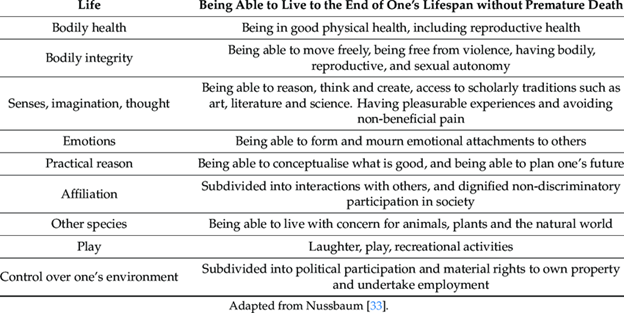
One of the most perplexing challenges in Global Health is determining the extent to which different countries value the ‘Right to Health’. The highest attainable standard of health is the right of every person to access health care that is affordable, of high quality, available and acceptable. This fundamental right was introduced in the Declaration of Alma Ata in 1978 in which Health for All by 2000 was the goal such that all people would have a level of health needed to fulfil their capabilities. The capabilities approach was first articulated by Nussbaum ( ) and focuses on ten human capabilities that allow for people to live a dignified life and attain their highest level of health in cooperation with others as indicated in the Table below.
Table: Nussbaum’s Capabilities Approach
Source: Adapted from Nussbaum, 1988
Health Financing
Financing is a simple term that means to fund the provision of health care. Financing is essential for a Health Systems ability to maintain and improve human health.
| Health financing refers to the “function of a health system concerned with the mobilization, accumulation and allocation of money to cover the health needs of the people, individually and collectively, in the health system… the purpose of health financing is to make funding available, as well as to set the right financial incentives to providers, to ensure that all individuals have access to effective public health and personal health care” (WHO 2000). |
The goals of health financing systems are to both raise funds for health but also to ensure that people who use health care services are not put at risk of financial hardship due to costs of accessing the needed services. Therefore, the objectives of financing are to raise sufficient funds and to provide financial risk protection to the population. Sometimes a third objective is added which calls for the available funds to be used efficiently so efficiency of resource use is often seen as a third health financing objective. Health financing strategies to raise funds include a mixture of domestic funds and external funds from global health donors such as the World Bank, International Monetary Fund, WHO and Non Governmental Organizations (NGOs). Despite these sources of revenue, many low and middle income countries do not have enough funding to provide for even basic essential services or health insurance for individuals. Financial risk protection strategies involve pooling of funds raised in order to spread risks across population groups. User charges are often used to gain health care access but run the risk of producing financial hardship on lower income individuals and families or disincentivizing sick people from seeking services in the first place. Financing policy must focus on how to raise funds equitably which suggests that rich contribute a higher proportion of their income than the poor. In addition, the strategy of pre-payment (through insurance premiums or taxes) when people are healthy and pooling these resources so that they are available when sick is known as risk pooling. With regard to efficiency in the use of resources, financing policy strategies involve deciding which interventions should be available and at what cost, who should provide the services (public or private sector), how to ensure quality and whether to target specific types of services or incentives to the poor.
Core Indicators in Health Financing
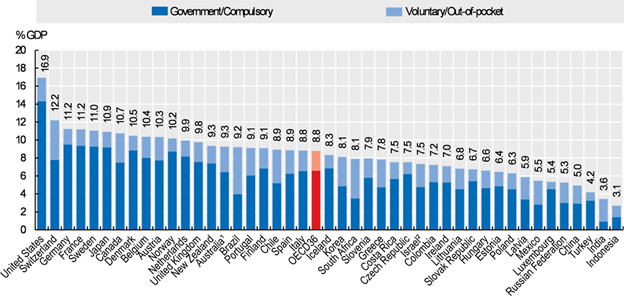
In most countries, health expenditures are provided to the Ministry of Health but are made available through the Ministry of Finance. One important core indicator of Health Systems is the mount of money a country spends on its health sector. Total health expenditures as a share of a country’s Gross Domestic Product (GDP) is often used as a measure to compare across countries. This is related to the notion of how much funding is raised for health and reflects the commitment of a country’s government to support health improvement. As is indicated in the bar graph below, the total health expenditure as a share of GDP varies substantially across countries. Most higher-income countries spend between 8% to 12% while the United States spends about 17% and Indonesia spends about 3%.
There is also a wide range in the share of total expenditure on health that is voluntary out of pocket expenditure. Out of pocket payments for health is the second core indicator in health financing. In general countries with better developed health insurance systems (United States, Germany, France) spend less in out of pocket costs while countries with less developed health insurance systems (India, Brazil, South Africa) spend much more as a percentage of overall health expenditures. This has implications for understanding the linkage between health expenditures and health outcomes where countries that spend less on health in their national budgets tend to have poor health outcomes. The bar graph below provides an example of how both of these core indicators can be used to make comparisons across countries on their health financing policies (WHO, 2008).
<iframe src=”https://data.worldbank.org/share/widget?end=2018&indicators=SH.XPD.CHEX.PC.CD&start=2018&view=map&year=2000″ width=’450′ height=’300′ frameBorder=’0′ scrolling=”no” ></iframe>
Health Expenditure as a share of GDP, 2018
Source: OECD Health Statistics 2019, WHO Global Health Expenditure Database.
Universal Health Coverage
We introduced the concept of Universal Health Coverage (UHC) in Section 1.7 in the Textbook. Goal 3 of the Sustainability Development Goals (SDGs) is to achieve Universal Health Coverage (UHC). Simply put, UHC seeks to have all people receive the health care services they need with out suffering financial hardships (WHO, 2013). In 2015 400 million people lacked access to basic essential health care services (World Bank, 2015). Furthermore, each year approximately 100 million people become impoverished due to health care related fees (Mills, 2014). The WHO estimates that achieving UHC would results in the prevention of 97 million premature deaths globally between now and 2030 and would add again of approximately 8.4 years to the life expectancy in some low income countries (WHO, 2017).
UHC means that all individuals and communities receive the health services they need without suffering financial hardship. It includes the full spectrum of essential, quality health services, from health promotion to prevention, treatment, rehabilitation, and palliative care across the life course.
The delivery of these services require adequate and competent health and care workers with optimal skills mix at facility, outreach and community level, and who are equitably distributed, adequately supported and enjoy decent work.UHC strategies enable everyone to access the services that address the most significant causes of disease and death and ensures that the quality of those services is good enough to improve the health of the people who receive them.
Protecting people from the financial consequences of paying for health services out of their own pockets reduces the risk that people will be pushed into poverty because unexpected illness requires them to use up their life savings, sell assets, or borrow – destroying their futures and often those of their children.
Achieving UHC is one of the targets the nations of the world set when adopting the SDGs in 2015. Countries reaffirmed this commitment at the United Nations General Assembly High Level Meeting on UHC in 2019. Countries that progress towards UHC will make progress towards the other health-related targets, and towards the other goals. Good health allows children to learn and adults to earn, helps people escape from poverty, and provides the basis for long-term economic development.
WHO contributes to achieving the Thirteenth General Programme of Work 2025 target that 1 billion more people benefit from UHC, while also contributing to the 2 other billion targets of 1 billion more people better protected from health emergencies and 1 billion more people enjoying better health and well-being. It also contributes to WHO’s mission of the right to the highest attainable standard of health, to Health for All and the SDGs.
How can countries make progress towards UHC?
Many countries are already making progress towards UHC, although everywhere the COVID-19 pandemic impacted the availability the ability of health systems to provide undisrupted health services. All countries can take actions to move more rapidly towards UHC despite the setbacks of the COVID-19 pandemic, or to maintain the gains they have already made. In countries where health services have traditionally been accessible and affordable, governments are finding it increasingly difficult to respond to the ever-growing health needs of the populations and the increasing costs of health services.
Moving towards UHC requires strengthening health systems in all countries. Robust financing structures are key. When people have to pay most of the cost for health services out of their own pockets, the poor are often unable to obtain many of the services they need, and even the rich may be exposed to financial hardship in the event of severe or long-term illness. Pooling funds from compulsory funding sources (such as government tax revenues) can spread the financial risks of illness across a population.
Improving health service coverage and health outcomes depends on the availability, accessibility, and capacity of health and care workers to deliver quality people-centred integrated care. The COVID-19 pandemic dramatically demonstrated the invaluable role of the health and care workforce and the importance of expanding investments in this area. To meet the health workforce requirements of the SDGs and UHC targets, over 18 million additional health workers are needed by 2030. Gaps in the supply of and demand for health workers are concentrated in low- and lower-middle-income countries. The growing demand for health workers is projected to add an estimated 40 million health sector jobs to the global economy by 2030. Investments are needed from both public and private sectors in health worker education, as well as in the creation and filling of funded positions in the health sector and the health economy. The COVID-19 pandemic, which has initially affected the health workforce disproportionately, has highlighted the need to protect health and care workers, to prioritize investment in their education and employment, and to leverage partnerships to provide them with decent working conditions.
UHC emphasizes not only what services are covered, but also how they are funded, managed, and delivered. A fundamental shift in service delivery is needed such that services are integrated and focused on the needs of people and communities. This includes reorienting health services to ensure that care is provided in the most appropriate setting, with the right balance between out- and in-patient care and strengthening the coordination of care. Health services, including traditional and complementary medicine services, organized around the comprehensive needs and expectations of people and communities will help empower them to take a more active role in their health and health system. Investments in quality primary health care will be the cornerstone for achieving UHC around the world.
Achieving UHC requires multiple approaches. The primary health care approach and life course approaches are critical. A primary health care approach focuses on organizing and strengthening health systems so that people can access services for their health and wellbeing based on their needs and preferences, at the earliest, and in their everyday environments. PHC entails three inter-related and synergistic components, including: comprehensive integrated health services that embrace primary care as well as public health goods and functions as central pieces; multi-sectoral policies and actions to address the upstream and wider determinants of health; and engaging and empowering individuals, families, and communities for increased social participation and enhanced self-care and self-reliance in health. Applying a life course approach optimizes people’s health by addressing their needs and maximizing opportunities across all phases of life so that they can be and do what they justifiably value at all ages, always guided by principles that promote human rights and gender equality.
As the COVID-19 pandemic showed, countries need to rapidly scale up their investments in essential public health functions—those core public health functions that require collective action and can only be funded by governments or risk large market failures. These include policy making based on evidence, communication including risk communication and community outreach to empower individuals and families to better manage their own health, information systems, data analysis, and surveillance, laboratory capacity for testing; regulation for quality products and healthy behaviours, and subsidies to public health institutes and programmes.
Can UHC be measured?
Yes. Monitoring progress towards UHC should focus on 2 things:
- The proportion of a population that can access essential quality health services (SDG 3.8.1)
- The proportion of the population that spends a large amount of household income on health (SDG 3.8.2).
Measuring equity is also critical to understand who is being left behind—where and why.
Together with the World Bank, WHO has developed a framework to track the progress of UHC by monitoring both categories, taking into account both the overall level and the extent to which UHC is equitable, offering service coverage and financial protection to all people within a population, such as the poor or those living in remote rural areas.
WHO uses 16 essential health services in 4 categories as indicators of the level and equity of coverage in countries:
Reproductive, maternal, newborn and child health:
- family planning
- antenatal and delivery care
- full child immunization
- health-seeking behaviour for pneumonia.
Infectious diseases:
- tuberculosis treatment
- HIV antiretroviral treatment
- use of insecticide-treated bed nets for malaria prevention
- adequate sanitation.
Noncommunicable diseases:
- prevention and treatment of raised blood pressure
- prevention and treatment of raised blood glucose
- cervical cancer screening
- tobacco (non-)smoking.
Service capacity and access:
- basic hospital access
- health worker density
- access to essential medicines
- health security: compliance with the International Health Regulations.
Each country is unique, and each country may focus on different areas, or develop their own ways of measuring progress towards UHC. But there is also value in a global approach that uses standardized measures that are internationally recognized so that they are comparable across borders and over time.
WHO role
UHC is firmly based on the 1948 WHO Constitution, which declares health a fundamental human right and commits to ensuring the highest attainable level of health for all.
WHO is supporting countries to develop their health systems to move towards and sustain UHC, and to monitor progress. But WHO is not alone: WHO works with many different partners in different situations and for different purposes to advance UHC around the world.
Some of WHO’s partnerships include:
- UHC2030
- Alliance for Health Policy and Systems Research
- P4H Social Health Protection Network
- UHC Partnership
- Primary Health-Care Performance Initiative
On 25–26 October 2018, WHO in partnership with UNICEF and the Ministry of Health of Kazakhstan hosted the Global Conference on Primary Health Care, 40 years after the adoption of the historic Declaration of Alma-Ata. Ministers, health workers, academics, partners and civil society came together to recommit to primary health care as the cornerstone of UHC in the bold new Declaration of Astana. The Declaration aims to renew political commitment to primary health care from governments, non-governmental organizations, professional organizations, academia and global health and development organizations.
All countries can do more to improve health outcomes and tackle poverty, by increasing coverage of health services, and by reducing the impoverishment associated with payment for health services.
UHC achievement is also thought to help in maintaining social order which strengthens national security by providing for a sense of social solidarity withing the population (Heymann et al., 2015) because uncertainties associated with the high costs of accessing health care have been seen to lead to civil unrest, UHC also works to strengthen Health Systems which is critical for mobilizing against public health emergencies such as infectious diseases such as Ebola and COVID 19. Weaker Health Systems are not prepared to cope with such emergencies and allows diseases to spread to other parts of the world, disrupting social and economic sectors throughout the globe. However, for countries with less resources in their governmental budgets, achieving a system of UHC can be challenging.
Categorization of Health Systems
As noted earlier, Health Systems are complex and are based on several determinants of health including the history, politics and values of a country. As the GDP of a country rises, the more likely the country is to increase its expenditures on the Health System. Brin, Pallay and Holtz (2009) suggest three major categories of Health Systems as follows:
National Health Insurance
- Insurance to all people for agreed package of services
- Insurance through the government or through a number of different insurance providers who cover same packages of services
National Health Service
- Government is sole payer for health care & owns most health care facilities
- Small private health sector
Pluralistic
- Public sector, private for profit sector and not-for-profit sector all play important roles
Most low-income countries have fragmented Health Systems that include both public and private providers. In these Health Systems, private providers often operate unlicensed. Many middle-income countries have their Health Systems organized around a national insurance scheme. In addition, almost all high-income countries have a national health insurance system with one exception, the United States, which resembles more of a fragmented system with both public and private providers.
In the table below we explore the similarities and differences in various Health Systems and their approaches to ‘Health as a Right’, ownership of facilities, employment of providers, form of insurance and financing of insurance (Brin, Pally & Holtz, 2009; Skolnik 2019)
Table: Similarities and Difference across Health System Categories
| Approaches | National Health Service | National Health Insurance | Pluralistic |
| Right to Health | Fundamental | Fundamental | Health as personal good |
| Ownership of Facilities | Mostly public | Mostly public & private, not for profit | Public; Private, for profit & Private not for profit |
| Provider Employment | Health service, private | Mostly private | Mostly private |
| Forms of Insurance | Public insurance linked to health service | Government as single payer & firms working w/ government | Public insurance; private, for profit & private, not for profit insurance; many lack insurance |
| Financing of Insurance | Mostly tax based | Mix of individual premiums, employee/employer payroll taxes, tax based | Taxes; Employer & employee insurance contributions; individual purchase of insurance; out of pocket |
| Country Examples | UK, Cuba | France, Canada, Japan, Germany, Brazil, Mexico, Thailand | India, Nigeria, United States |
Source: Adapted from Brin, Pallay & Holtz, 2009
In the table below, we provide some examples of Health Systems according to income level.
Table: Selected Examples of Health Systems by Country Income Group
| High Income Countries | Upper Middle-Income Countries | Lower Middle-Income Countries |
| Germany First country to have universal health insuranceInsurance carriers for mandatory insurance are “sickness funds” financed by employers and employees and cover 90% of the populationStatutory health insurance package; about 10% of population opts for private insurance | Brazil Universal coverage through decentralized systemThe public system (SUS) based on Family Health Program (PSF) and covers 70% of populationSUS funded by general tax contributionsPrivate insurance purchased by individuals with possible support from employers | India Federal system of tiered network of health services in the public sectorThe private sector treats almost 80% of outpatients and 60% of inpatientsOnly 30% of population covered by insurance RSBY is a new insurance scheme for those below poverty line |
| The United Kingdom Universal health coverageNational Health Service (NHS) is responsible for health services and related insurance75% of NHS funding comes from general taxes and the rest mostly from a payroll taxAbout 11% of population opts to buy private insurance | Costa-Rica Commitment to universal coverageCosta Rican Social Security Administration (CCSS) is both financier and provider of health servicesFormal sector employees are obliged to participate in the CCSS, informal sector workers may join for fees on a sliding scale, and costs of the poorest covered90% of financing of CCSS comes from employer and employees | Ghana Committed to universal coverageIn 2003, established National Health Insurance System (NHIS), funded by value added taxPublic system is a pyramid of services at different levels“Cash and carry system” of user fees constrains the demand and use of services for the poor |
| The United States Complex and fragmented Over half of the population has private insurance, about 30% are covered by government insurance, and about 15% are uninsuredNo standard package of insurance benefits for all but minimum package for those with insurance |
Source: Adapted from Skolnik, 2019
Another way of classifying Health Systems has been offered by Merton et al which uses the following criteria:
- Financing Methods (e.g., tax, social insurance, private insurance, out of pocket payments)
- Political Philosophy (e.g., capitalist, socialist)
- Scope of Intervention (e.g., cover whole population or only the poor)
- Country Income Level (e.g., low, middle, high)
- Historical or Cultural Attributes (e.g., industrialized, non-industrialized, transitional)
How Do We Measure Health System Performance?
The performance of Health Systems is another area of interest to Global Health. Performance measurement provides information on how well a Health System is doing on certain aspects thought to improve individual and population health outcomes such as mortality and morbidity from diseases, illnesses, conditions and injuries. The performance measures also allow for countries to compare themselves to others using a standardized system in which countries are ranked according to their levels of performance.
Performance rankings are based on an index of three factors:
- Health Status – measured in disability life expectancy. This accounts for 50% of the index
- Responsiveness – measured as speed of service, protection of privacy and quality of amenities. This accounts for 25% of the index
- Fair Financial Contribution – measured as the risk each household faces of going into poverty due to the costs of accessing the health care system, compared to the risk of illness. This accounts for 35% of the index
Table: Ranking of Current Top 20 Health System Performers
| Country | Healthcare Rank | 2021 Population |
| France | 1 | 65,426,179 |
| Italy | 2 | 60,367,477 |
| San Marino | 3 | 34,017 |
| Andorra | 4 | 77,355 |
| Malta | 5 | 442,784 |
| Singapore | 6 | 5,896,686 |
| Spain | 7 | 46,745,216 |
| Oman | 8 | 5,223,375 |
| Austria | 9 | 9,043,070 |
| Japan | 10 | 126,050,804 |
| Norway | 11 | 5,465,630 |
| Portugal | 12 | 10,167,925 |
| Monaco | 13 | 39,511 |
| Greece | 14 | 10,370,744 |
| Iceland | 15 | 343,353 |
| Luxembourg | 16 | 634,814 |
| Netherlands | 17 | 17,173,099 |
| United Kingdom | 18 | 68,207,116 |
| Ireland | 19 | 4,982,907 |
| Switzerland | 20 | 8,715,494 |
| Belgium | 21 | 11,632,326 |
| Colombia | 22 | 51,265,844 |
| Sweden | 23 | 10,160,169 |
| Cyprus | 24 | 1,215,584 |
| Germany | 25 | 83,900,473 |
| Saudi Arabia | 26 | 35,340,683 |
| United Arab Emirates | 27 | 9,991,089 |
| Israel | 28 | 8,789,774 |
| Morocco | 29 | 37,344,795 |
| Canada | 30 | 38,067,903 |
| Finland | 31 | 5,548,360 |
| Australia | 32 | 25,788,215 |
| Chile | 33 | 19,212,361 |
| Denmark | 34 | 5,813,298 |
| Dominica | 35 | 72,167 |
| Costa Rica | 36 | 5,139,052 |
| United States | 37 | 332,915,073 |
| Slovenia | 38 | 2,078,724 |
| Cuba | 39 | 11,317,505 |
| Brunei | 40 | 441,532 |
Source: Measuring Overall Health System Performance for 191 Countries (who.int)
It should be noted that the Performance Rankings are not without controversy. Concerns raised over the factors considered, data sets used and comparison methodologies have led health bodies and political commentators in most of the countries on the list to question the efficacy of its results and validity of any conclusions drawn. In over 20 years, the discussion and controversy over the WHO Rankings of Health Systems Performance have not led to any consensus about how an objective world health system ranking should be compiled. The debate still rages on!
Finally, Health Systems are often thought of as social institutions. Gilson (2003) notes that Health Systems should be considered to be more than “delivery points for bio-medial interventions.” Health Systems can be conceptualized as organizations that are based on trusting relationships between providers and patients, employees and employers and between various providers. Merton asserts that “A key influence in these relationships is the concept of trust, whose formation and maintenance require adequate managerial and organizational practices and political processes, and a focus on equity and justice.”: (p. 1866)
Major Challenges for Health Systems
According to Skolnik (2019) Health Systems face a series of challenges in attempting to achieve the goal of improving health for their populations. The challenges are:
- Demographic and Epidemiologic Change
- Stewardship
- Human Resource Issues
- Quality of Care
- Financing of Health Systems
- Financial Protection and Provision of Universal Coverage
- Access and Equity
Let’s take a deeper look at describing some of the issues that each of these challenges presents and look at some possible strategies to overcome each of the Health System challenges in the table below
| Health System Challenge | What is the Challenge? | How can it be addressed? |
| Demographic and Epidemiologic Change | People are living longer so societies will face a greater burden of noncommunicable diseasesCost of treating noncommunicable conditions is highPoor countries simultaneously face a triple burden of disease: communicable disease, noncommunicable disease, and injuries | Reduce cardiovascular disease burden related to tobaccoTake measures to reduce road traffic accidentsStrengthen health systems Adopt models of care that sustain more frequent contacts with patients |
| Stewardship | High-income countries: clear rules and can enforce those regulationsLow- and middle-income countries: problems of governancePenalize poor people in particular because they have less choice and power Weak management of human resources Poor facilities, absenteeism, and corruption can also be problems | Launch national anticorruption programs Reform procurement systems Increase audits of the health systemContract out services as appropriate and cost-effectiveCarry out customer satisfaction surveysEngage community oversight with “citizen report cards” |
| Human Resource Issues | High-income countries: imbalance in types of personnelPoorest countries: not enough healthcare personnel, who are poorly distributed and often poorly trained and motivatedHuman resource problems compounded by the “Brain Drain” | More shared global responsibility for resources More explicit strategies for workforce development focusing on coverage, motivation, and competenceTask-shifting: train lower-level personnel to carry out functions usually reserved for higher-level staffFinancial incentives |
| Quality of Care | Health services should be safe, effective, patient-centered, timely, efficient, and equitableQuality varies between and within systems Causes can include poor management, lack of financial resources, poorly trained staff, unempowered patients, and no system for monitoring the performance of the health system | Carry out assessments of quality gaps Better professional oversight, supervision, and continuing training Use of clear guidelines, protocols, and algorithmsWhen contracting out services, link payment to performance Focus on staff being proficient at selected tasks |
| Financing of Health Systems | High-income countries: issues of rising costs due to aging populations and use of new technologiesLow- and middle-income countries: absolute lack of public sector financial resources for healthMany low-income countries do not provide enough public funds to ensure delivery of an appropriate basic package of services, between $12 and $50 per personMany countries fail to maximize the value of their health investments | Shift resources from other areas of the economy because of high ROI in healthShift expenditure within health sector to a selected group of low-cost, highly effective investments20–40% of expenditures on health in low-income countries are wasted by spending that is not effective or efficient |
| Financial Protection and Provision of Universal Coverage | Capacity of people to pay for health services is a barrier to access; catastrophic costs impoverish people in many settingsNot a problem in most high-income countries with social insurance schemes that essentially offer health insurance to all citizens | Raise additional revenue Improve efficiency of health sector expenditure Reduce dependence on out-of-pocket expenditures Enhance equity Move toward and aim to provide basic primary care package |
| Access and Equity | Lack of coverage of basic health services in areas where poor, rural, and minority people liveService coverage with a lower level of inputs in these areas Service coverage that varies with income and education levels Unequal access to relatively expensive services | Question of political will and health systems planningUse data from national surveys to identify gaps in health status Specifically target health resources to the places most in need and the poor |
Source: Adapted from Skolnik (2019)
| Brain Drain refers to the migration of health care providers to other places in the world usually because of better living conditions such as higher salaries, access to technology and political stability Task Shifting refers to the redistribution of health care tasks from those with higher levels of training to those with less training in order to reduce costs and improve efficiency |
Now that we have outlined some of the major challenges and possible solutions in Health Systems, it is useful to consider at which level in the Health System these solutions could best be implemented. Global Health research indicates that the Primary Care level is the most appropriate level for these solutions to take place. It is recommended that health systems, especially in low and middle income countries, should:
- Focus services on the main burdens of disease
- Strengthen the health system to deliver services effectively and efficiently
- Offer a primary care package of essential services through primary care clinics and district hospitals
The package of essential services should include the following interventions”
- Maternity-related interventions
- Childhood disease-related interventions
- Malaria prevention and treatment
- TB treatment
- HIV prevention and care
- Tobacco and alcohol control programs
Working Together in Health Systems
The World Health Organization WHO is responsible for setting the Global Health Agenda. Ministers of health of WHO member countries meet once a year at the World Health Assembly. During the Assembly the members discuss the newest reports and advocacy efforts of WHO, multilateral and bilateral agencies and NGOs. Investments made by development partners, such as Bill & Melinda Gates Foundation a major NGO, raise attention to health matters during Assembly meetings. In addition, popular action led by NGOs or other advocates, such as MSF, PIH, influence the setting of the agenda through advocacy efforts and shifting prevailing opinions. All of these actors are engaged in the creation, implementation and evaluation of Global Health interventions including those initiated by Health Systems.
As we conclude our exploration and understanding of Health Systems, we should keep in mind that improving the health of the population is the ultimate goal. This goal can be met by ensuring that every person has access to a package of essential services. In addition, each person should be covered by an insurance arrangement that protects them from financial costs that result in impoverishment. Special emphasis should be made in ensuring that poor and marginalized populations have access to insurance and a basic package of essential services and that they have a ‘voice’ in determining the overall design of the Health System and access to Universal Health Coverage.
